

Advertisement
18 Things Only People Who Grew Up With a Rotary Phone Will Remember
The TriviaTalent Team · 8 min read
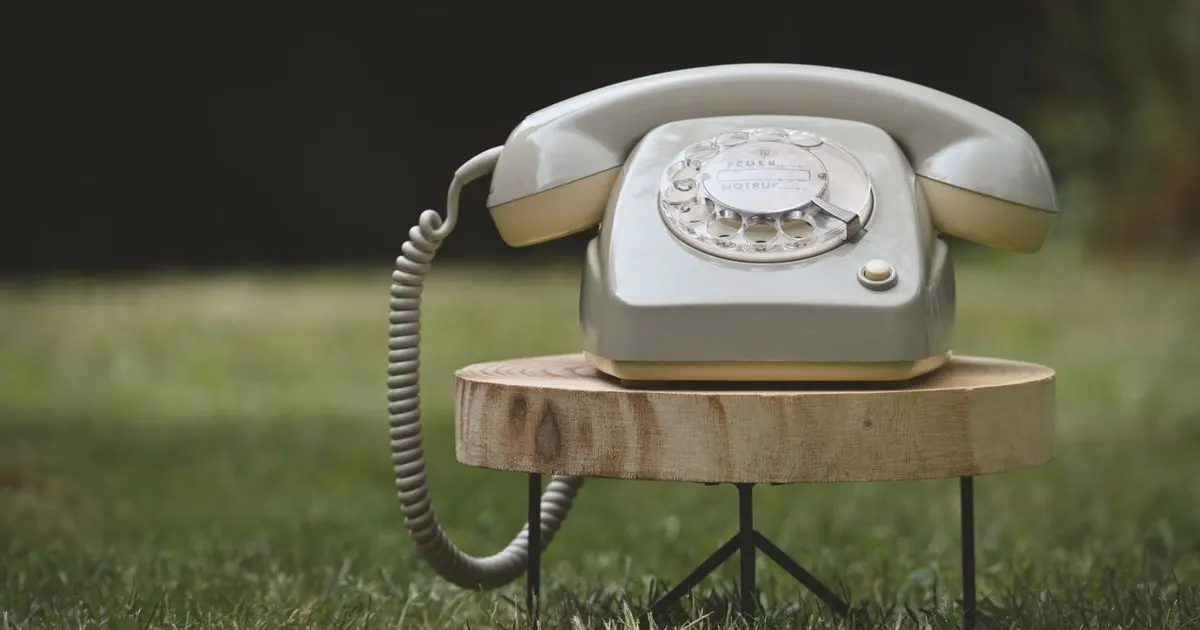
It lived in the hall, or on the kitchen wall, and it was the color of everyone else’s. When it rang, the whole house heard it, and somebody hollered “I’ll get it!” before the second ring. You picked up a receiver that had real heft to it, pressed it to your ear, and the cord curled down toward the floor like a question mark.
If you came up before the push buttons and the pockets, the telephone was a place as much as a thing — a spot you stood in, tethered by a cord, while the family pretended not to listen. Here are 18 things only the people who grew up with a rotary phone will really remember.
1. The phone wasn’t yours — you rented it
That sturdy black desk set, the one that could double as a doorstop, didn’t belong to you. For decades the Bell System owned the telephone in your house and leased it to you by the month, right on the bill. The classic Western Electric Model 500 was the standard American desk phone from 1950 all the way to 1984, and a molded plastic shell over a steel frame is exactly why it felt built to outlast you.
2. One color, then suddenly a rainbow
For the first few years you could have any color you liked, as long as it was black. Then, in 1954, the phone company began offering sets in ivory, green, red, brown, beige, yellow and blue, and a colored telephone in the hallway became a small, proud sign of a modern home.
3. Dialing took real time, and real patience
You put a finger in the hole, pulled the wheel around to the little metal finger stop, and let it spin back on its own before the next digit. A number full of nines and zeros felt like it took forever — and it practically did, since a zero sent ten clicks down the line and a one sent just a single click. Slip near the end of a long number and there was nothing to do but hang up and start the whole thing over.
4. You shared your line with the neighbors
Plenty of families didn’t have a line to themselves at all. A party line was a single circuit split among several households because it cost less than private service — and in the middle of the last century, most telephone customers were on one. In 1943, nearly three-quarters of the homes in Pennsylvania shared a party line, and folks were asked to keep their calls under five minutes.
5. You learned your own ring
On a party line every phone rang for every call, so you learned your household’s own pattern — two long rings and a short one, say — and you let the others go. Pick up a call that wasn’t yours by mistake and you’d be apologizing to a neighbor before you’d said hello.
6. And so did the nosy neighbor down the road
A party line gave you no privacy whatsoever. Anyone sharing it could lift their receiver and listen in on your conversation, and you often heard the tell-tale little click that meant someone had. You learned to say the important things carefully, or to save them for when you could get the line to yourself.
7. Your phone number started with a word
Before the all-digit numbers, your number began with the name of your exchange, and you dialed its first two letters. PEnnsylvania 6-5000 meant you spun PE and then the six and the rest — a real number so catchy that Glenn Miller turned it into a hit song. Those named exchanges, from BUtterfield to KLondike, slowly gave way to plain numbers after the phone company published its list of recommended names in 1955.
8. “Number, please”
Somewhere down the line sat an operator, and in many towns you reached her simply by dialing 0. “Number, please,” she’d say, and she’d connect you by hand, or find the number you’d lost, or break in on a line in an emergency. She often knew half the town by voice.
9. You knew every number by heart
There was no list of contacts in your pocket to tap. You carried your friends’ and relatives’ numbers in your head, scrawled the rest in a little book kept right by the phone, and could still rattle off your childhood number today without stopping to think.
10. The cord that stretched clear around the corner
The handset hung on a coiled cord, and you stretched that cord for all it was worth — around the door frame, into the pantry, as far as it would go so you could have a private word. It tangled into hopeless knots, and someone always tripped over it in the kitchen.
11. The busy signal meant: try again later
There was no voicemail to catch a missed call and no way to leave a message in the air. If the line was busy, you got that flat, insistent tone, you hung up, and you tried again in a little while. Sometimes you tried all evening.
Advertisement
12. Long distance was for special occasions
A call across the country was an event, not an afterthought. It cost enough that you kept it short and saved it for news that mattered, and the whole family might crowd around to take a turn. “Keep it quick,” someone would whisper, “this is long distance.”
13. The nickel — then the dime — in the pay phone
Out in the world, you called home from a pay phone, and you fished in your pocket for a coin. A local call cost just a nickel into the 1950s, then a dime for decades after, dropped with a satisfying clink into a three-slot box that took nickels, dimes and quarters. It’s where the old phrase “drop a dime” comes from.
14. The phone booth with the folding door
And often that pay phone stood in a booth of its own — a glass box with a folding door that you pulled shut, a little light that blinked on, and a fat phone book dangling from a chain. You stepped inside, closed the door against the street noise, and the world shrank to a quarter and a dial tone.
15. The Princess phone on the nightstand
In 1959 the phone company brought out the Princess, a small, pretty set made for the bedroom and marketed squarely at women and teenage girls. Its dial glowed in the dark so you could find it at night, and the advertisements promised, “It’s little…it’s lovely…it lights.” A teenager who got one in her room felt like she’d truly arrived.
16. The day the buttons arrived
Then came the push buttons. Touch-Tone dialing was shown off to the public at the 1962 World’s Fair, and little by little those musical beeps began to replace the whir of the dial. The first time you pressed a number instead of spinning it, it felt like something out of the future.
17. The slow goodbye to the party line
The shared line hung on far longer than you’d think, especially out in the country where stringing a private wire to a distant farmhouse simply cost too much. Most towns had let go of party lines by the late 1980s, but as late as the year 2000 there were still thousands of them scattered across the United States.
18. The telephone was a place you went
Above all, the phone stayed put, and so did you. A call happened in the hall or at the kitchen wall, on a cord only so long, where anyone passing could hear your end of it. You couldn’t wander off with it or carry it in a pocket — and maybe that’s why those conversations, standing in one spot with the cord wound around your finger, are the ones you still remember.
Frequently asked questions
Why did a party line have no privacy?
Because it was one physical circuit shared by several households. Any subscriber on the line could quietly pick up their own receiver and hear whatever was being said. It was the trade-off for cheaper service, and in much of the country it was simply how the telephone worked for decades.
What did a number like PEnnsylvania 6-5000 actually mean?
The first part was the name of your telephone exchange, and you dialed its first two letters using the same letters printed on the rotary dial. “PE” stood for the numbers 7 and 3, so PEnnsylvania 6-5000 was really 736-5000. The phone companies phased these named exchanges out in favor of all-number calling through the 1960s.
When did push-button phones replace the rotary dial?
Touch-Tone push-button dialing was introduced to the public at the 1962 World’s Fair, and push-button phones gradually took over from the 1960s onward. Rotary phones lingered in plenty of homes well into the 1980s and beyond, so the two overlapped for a long while.
Did people really not own their telephones?
For most of the rotary era, no. The telephone was owned by the Bell System and leased to you, which is why the sets were so uniform and so sturdy. That changed after the Bell System was broken up in 1984, when customers could finally buy a phone outright.
Sources
Can you still hear that dial tone? Play our trivia quizzes and take another stroll back down memory lane. If this brought things back, you’ll enjoy our look at the vanished summer jobs of the ’60s and ’70s and things from the 1950s you don’t see anymore.
Think you remember it all? Put your memory to the test:
 Geography
?10 Questions
Global Gateways: Major International Airports Quiz
Try QuizAdvertisement